

|
|
|
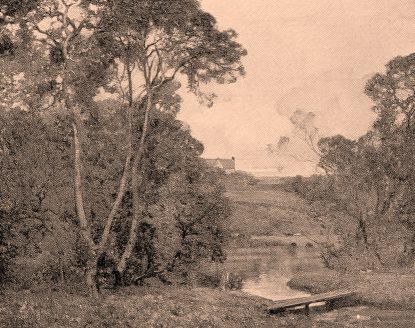
and let that suggest the material. Or, take another case. Under the trees some cows are resting, and the sunshine dapples over them a pattern of light and shade.You know full well that the red and white, and the light and shadow of their hides, are composed of multitudes of fine hairs, but you do not dream of attempting the task of painting them. At the same time you should not paint the cattle as you would a door; with flat paint that would reveal nothing of the truth of the material it is intended to represent. So with trees and grass. Our knowledge informs us that the grass field on the distant hillside is green. But hold up a few blades of the same material at arm's length for comparison, and you will find that the apparent distant "green" is not green at all, because of the effect of the intervening atmosphere. You have to paint it so as to render the same impression as that of Nature, and to convince the spectator that though you paint it a yellow or blue- grey, it is identical in colour with the meadow at your feet.*
Many illustrations could be added, if necessary, to emphasise this principle, but I have said enough I think to convince you of the absurd notion, promulgated by some, that the closer imitation of Nature in detail shows greater knowledge. It is not so. The subtler knowledge of Nature is evinced by the artist who knows Nature so well that he can adapt it to his own purpose. It is so in all things. The writer and the musician proceed on the same method. It would be absurd to say that the mere reproduction of natural sounds is music, or that a faithful description of a locality in a guide book is literature. I remember an exhibition of landscapes which were submitted in competition for a prize. Although the prize was offered for a landscape, it was given to the painter of a careful study of rushes on a river bank. No doubt it was a faithful study, and the rushes were excellently painted, but it was not a landscape; and all those who had painted landscapes were naturally surprised at the award. Its supposed merit consisted in the most servile imitation of Nature, which excluded every particle of the personality of the painter, and only the abject ignorance of the character of things was revealed. It will be interesting to follow the career of that young artist if he paints his landscapes in that spirit. He would have done better had he learnt more of the possibilities of the growth of his rushes, so that he could include them in any form when it was necessary.
Your picture may be said to be finished when it would be superfluous to add another touch to it, and when it rings in perfect harmony and rhythm of line and mass of tone and colour. The beauty and dignity of your composition, your scheme of colour, and all the personal and individual expression of your painting, should be full of that great quality which must be the dominant note of your picture, and that is the expression of the vital force and the convincing truth of Nature.
I have already pointed out the advantage of making studies direct from Nature, as aids to painting. How valuable, then, are studies of colour effects to those who paint their most important pictures in the studio, and who must, of necessity, depend upon them, and upon their recollection and impressions, for the truth they wish to convey.
So much has been said in support of painting direct from Nature, and there are so many advantages accruing from the practice, that I should advise the student at present to confine himself to that particular method. But it is nevertheless true, that some of the greatest landscapes in the world have not been painted on the spot; and it is also true that the artists who painted them only achieved success by passing through the curriculum and discipline I have attempted to describe. I feel
*See chapter on ,Grass" (p 72).
|
|
7 |
|